Platform Updates
How Wiring 5 Payment Processors Together Almost Killed Accustom
One payment processor flagged our business model as a "grey area" and froze funds overnight, with zero warning. Here's how we rebuilt Accustom's core money layer on-chain — and what it taught us.
 Accustom Team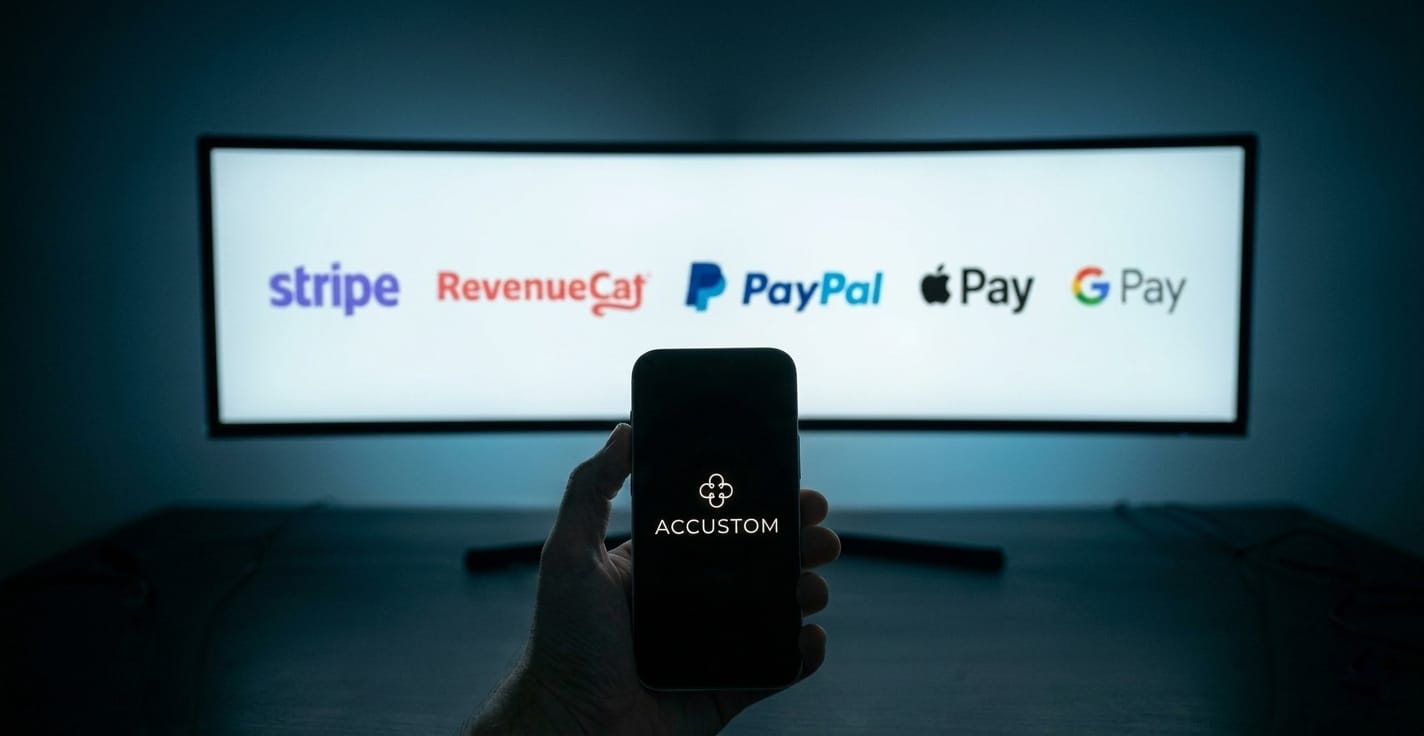
On this page
Accustom's core loop sounds simple: you stake real money on your own goals, and you get it back — plus a bonus — if you follow through. Making that promise actually work, safely and compliantly, meant wiring together a stack of five separate payment systems.
The stack
- Stripe — inbound stakes
- Apple Pay & Google Pay — in-app payment services
- RevenueCat — subscriptions
- PayPal — outbound rebates and payouts
Four vendors sitting underneath one core loop. It worked, but it meant a lot of surface area for something to go wrong — and if any single gateway failed, the whole system stopped end to end.
The day funds got frozen
With real users already onboarded and money already staked, one of our payment processors flagged Accustom's business model as a "grey area." No warning, no negotiation. Funds frozen, and a business model our own product depended on suddenly unsupported by a partner we had no leverage over.
That's the moment "if one gateway fails, the whole ecosystem collapses" stopped being a theoretical risk and became the thing actually happening.
The pivot: moving escrow on-chain
I'd worked with Web3 before and had deliberately avoided it for Accustom. The UX has a well-earned reputation for being clunky, and I didn't want to put that friction between users and their money. But with the app dead in the water, we needed a way to hold and release funds that didn't depend on one processor's risk appetite.
So we ripped out the fiat APIs and rebuilt the escrow layer on-chain:
- Smart contracts now handle payouts trustlessly — no processor can freeze funds or decide unilaterally that our model doesn't fit.
- Embedded wallets and fiat off-ramps run invisibly in the background — no seed phrases, no gas fees, nothing for the user to manage.
- Users still stake, complete goals, and get paid out exactly the way they always did. Only the infrastructure underneath changed.
I was genuinely surprised by how far the Web3 ecosystem has matured — the tooling that lets you hide all of that complexity from an end user simply didn't exist in a usable form the last time I'd built with it.
What this forced us to learn
Re-architecting Accustom's money layer mid-flight, with active users, was brutal. It pushed the whole build out of standard full-stack territory and into resilient, decentralized systems architecture — engineering we hadn't planned on doing this year.
The lesson we keep coming back to: sometimes the technology you've been actively avoiding is exactly what your product needs. We avoided Web3 because of its reputation for bad UX. We ended up needing exactly what it's good at — trustless, censorship-resistant custody of funds — while hiding the complexity that gave it that reputation in the first place.
Accustom is live, funds are moving again, and the core promise hasn't changed: put something real on the line, and follow through.
Keep building.
— The Accustom Team